Frequently asked questions
What PSI concrete should a garage floor be?
ACI 302.1R recommends 3,500 PSI as a minimum for garage floor slabs, which also satisfies IRC Table R402.2 in moderate and severe weathering zones. A steel-troweled finish may reduce air to 3% if strength is raised to 4,000 PSI.
Do I need a vapor barrier under a garage slab?
A 10-mil vapor retarder is recommended under any heated or finished garage floor and under floors that will receive coatings or floor covering. An unheated, detached garage can often omit it, but it still helps control slab moisture.
How thick does a garage slab need to be for a car lift?
Two-post and four-post lifts typically require a minimum 4–6 inches of 3,000–4,000 PSI concrete at the anchor locations, but the controlling number is always the lift manufacturer's foundation specification — verify it before pouring.
Start with the clear slab field
The default two-car preset is 24 × 24 ft at 4 inches thick. That rectangular field contains about 7.11 cubic yards before waste. It is a useful baseline, but it excludes any foundation element below or around the floor.
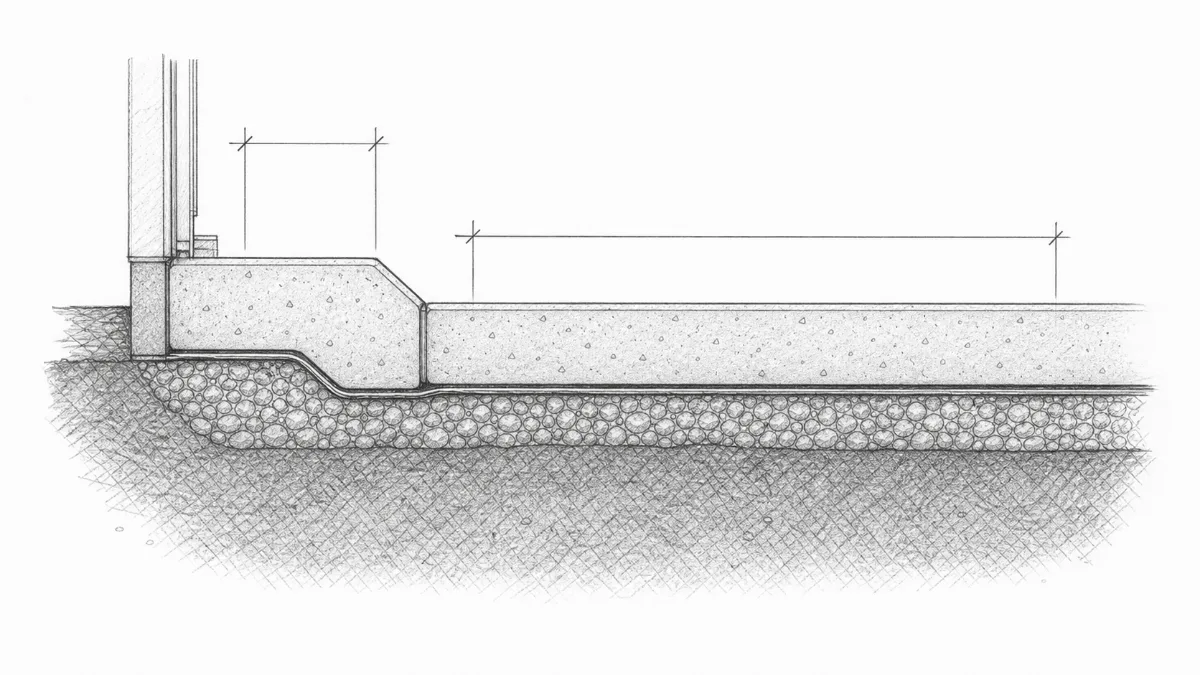
Check the drawings for turned-down edges, stem walls, strip footings, grade beams, door thickenings, equipment pads, trenches, sumps, and recesses. Calculate those shapes separately and avoid counting overlapping volumes twice.
Vehicle and equipment loads are not all alike
Pour Ready includes 4-inch general garage presets, 5-inch truck and workshop presets, and a 6-inch heavy-duty starting point. A vehicle lift or concentrated machine load must follow the manufacturer’s anchor layout and the structural design. Entering a thicker number estimates concrete; it does not validate the section or reinforcement.
Base, vapor, and drainage decisions happen before concrete
The calculator estimates road-base volume, but the project must establish subgrade preparation, drainage, capillary break, vapor-control requirements, insulation, and any under-slab services. Floor drains and door slopes alter the geometry and finishing plan. Confirm whether local rules permit the intended drainage connection.
Joint layout follows columns, doors, and placements
The standard joint planner is based on slab thickness and panel shape. Garage layouts add door openings, interior columns, pits, thickened pads, and wall lines. Plan joints before reinforcement and embedded items are finalized. Isolation may be needed around columns, walls, and independent equipment foundations.
Interior and apron exposure can differ
The protected interior floor may not face the same freeze-thaw and de-icing-salt exposure as the apron or door threshold. Separate pours or mix requirements may be appropriate. Pour Ready surfaces climate context, but the supplier and project documents should control strength, air entrainment, finishing, and curing.
ACI 302.1R recommends 3,500 PSI as a minimum for garage floor slabs. In moderate and severe weathering zones the IRC also requires 3,500 PSI with air-entrained concrete — 5 to 7% total air content — to resist scaling from freeze-thaw cycling and deicing salts. One exception: if the floor will receive a steel-troweled finish, air content can be reduced to 3% provided the mix strength is raised to 4,000 PSI. Confirm the target with the ready-mix supplier when placing the order.
Coordinate the pour, not just the order
A 24 × 24 ft floor often exceeds practical bag mixing and is a ready-mix placement. Confirm truck access, pump or chute reach, crew size, placement sequence, screed points, finishing equipment, curing materials, and weather protection. Order quantity is only useful when the placement plan can handle it.
Reinforcement, finishing, and curing sequence
Place temperature-and-shrinkage reinforcement in the upper third of the slab thickness, supported on chairs or concrete dobies set every 3 to 4 feet. Do not lay mesh flat on the subbase and pull it up during the pour — it almost never stays at the right depth and provides little benefit once displaced to the bottom of the slab.
Timing the finishing correctly is what separates a durable surface from one that dusts or scales. Wait until foot traffic leaves only a ¼-inch indentation before troweling. Finishing while bleed water is still visible traps moisture in the surface layer, which weakens the concrete there and creates scaling or crazing over time.
Begin curing immediately after the final finishing pass — do not wait for the surface to dry first. Cover the slab with wet burlap or polyethylene sheeting and maintain moisture for at least 7 days. If isolation joints along the garage walls and around columns were not placed before the pour, random cracking from restrained shrinkage is likely. Separation at the perimeter is especially important because the slab and the wall expand and contract at different rates.
Garage floor thickness and mix by duty
Garage floors carry concentrated wheel and jack-stand loads that ordinary patio slabs never see, so duty drives both thickness and strength. The baselines below follow ACI 302.1R and IRC Table R402.2; a vehicle lift or press always defers to the manufacturer's engineered foundation.
| Duty | Thickness | Strength | Reinforcement |
|---|---|---|---|
| Passenger cars | 4 in | 3,500 PSI | Welded mesh or fibers; rebar at thickened edges. |
| Trucks or workshop | 5 in | 3,500 PSI | #3–#4 rebar grid on chairs. |
| Heavy-duty or lift bays | 6 in and up | 4,000 PSI | Engineered; follow the lift anchor design. |
If the floor will receive a steel-troweled finish, IRC Table R402.2 permits reducing total air content to 3% provided the mix strength rises to at least 4,000 PSI — steel troweling air-entrained concrete too aggressively causes surface blisters.
Step by step: pouring a garage floor
A garage floor combines flatwork finishing with foundation-edge coordination, so the sequence below keeps the two from colliding on pour day.
- Prepare subgrade, base, and vapor barrier. Compact the subgrade to about 95% standard Proctor density and place a 4-inch granular base. Under a heated or finished floor, add a 10-mil vapor retarder, lapping seams about 6 inches.
- Form the perimeter and thickenings. Set the turned-down edge, door thickening, and any equipment pads per the drawings. Isolate the floor from stem walls and columns with ½-inch isolation-joint material so the slab can move independently.
- Set reinforcement on chairs. Position mesh or rebar in the upper third of the slab on chairs or dobies every 3 to 4 feet — never flat on the base to be pulled up later.
- Establish the drainage slope. Pitch the surface about ¼ inch per foot toward the overhead door or floor drain so wash water and snowmelt run out instead of pooling.
- Place from the back wall toward the door. Pouring toward the exit keeps the crew working off subgrade rather than finished concrete. Specify 3,500 PSI (or 4,000 PSI at 3% air for a steel-troweled finish).
- Screed and bull-float. Strike off to the slope and float once before bleed water appears, without overworking the surface.
- Edge, joint, and finish. After the bleed sheen leaves, cut control joints about one-quarter of the slab depth into panels of roughly 10 to 12 feet, then steel-trowel the interior or broom the apron and threshold for traction.
- Cure immediately for 7 days. Apply curing compound or cover with sheeting right after finishing to develop strength and limit curling at the joints.
Sources and further reading
Use this guide with the Pour Ready methodology page, garage foundation drawings, lift-manufacturer instructions, and local permit requirements.
- ACI 318 official code page for structural concrete scope and professional-review boundaries.
- 2021 IRC Chapter 4 Foundations for residential footing and foundation context.