Frequently asked questions
How thick should a concrete driveway be?
Plan 4 inches for light passenger parking, 5 inches for a standard two-car driveway, and 6 inches where pickups, RVs, or delivery trucks park. Each thicker section also wants a deeper compacted base.
What PSI concrete is best for a driveway?
3,000 PSI is the residential standard. In freeze-thaw climates, IRC Table R402.2 calls for 4,000 PSI air-entrained concrete with 5–7% air. Higher strength offers no real benefit for passenger vehicles in mild climates.
How long before you can drive on a new driveway?
Keep foot traffic off for about 24 hours, passenger vehicles off for roughly 7 days, and heavy trucks or RVs off for closer to 28 days while the concrete reaches full design strength.
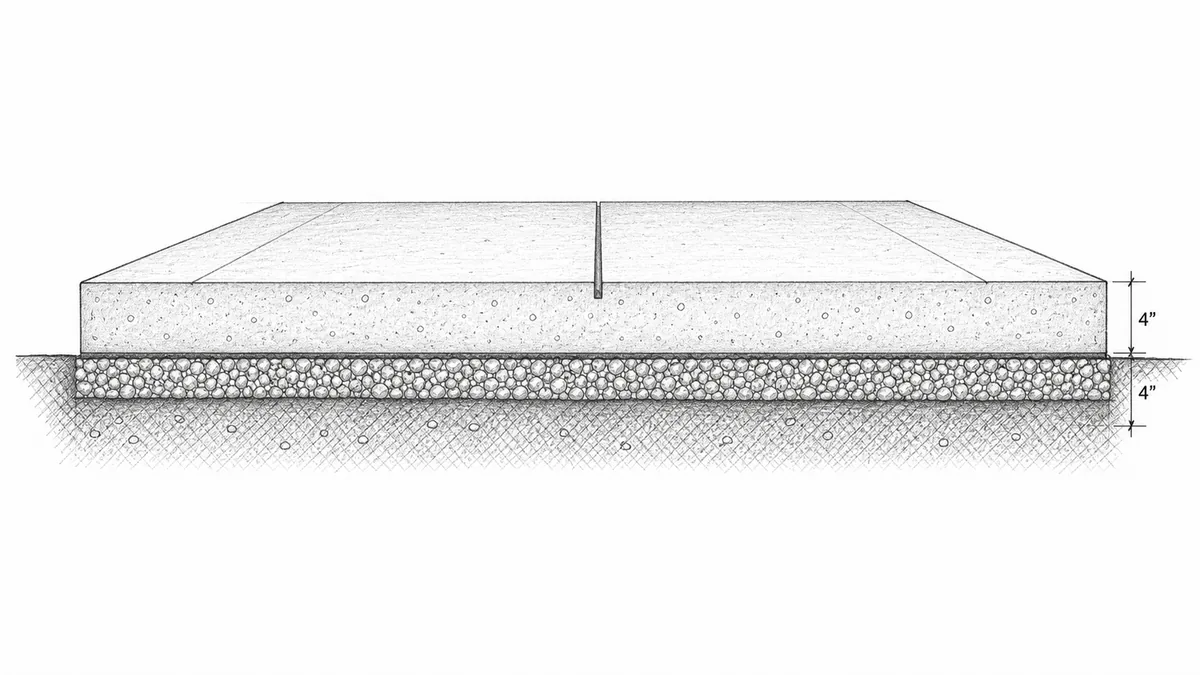
Use separate sections for separate loads
Pour Ready includes editable driveway presets from a 4-inch light-use parking area to 5-inch two-car sections and a 6-inch heavy pickup or RV pad. These presets make the quantity difference visible, but they do not determine what your site requires.
Map the driveway by use: normal passenger-vehicle lanes, turning areas, the street apron, vehicle crossings, garage transitions, and any heavy parking zone. Calculate sections separately when thickness, reinforcement, or base depth changes.
Base depth is not waste concrete
The default two-car preset uses a 6-inch road-base layer. The calculator reports both compacted base volume and loose order volume using a compaction factor. That distinction matters because material delivered loose occupies more volume than the finished compacted layer.
Remove organic material, correct soft areas, manage drainage, and compact in lifts appropriate to the equipment and material. Base recommendations depend on soil, climate, drainage, and local practice; a generic calculator cannot inspect those conditions. Dampen the compacted granular base immediately before the pour — a dry base pulls moisture from fresh concrete and can cause early-age shrinkage cracking at the bottom of the slab.
Thickness drives a large order swing
A 20 × 20 ft parking area contains about 4.94 cubic yards at 4 inches, 6.17 cubic yards at 5 inches, and 7.41 cubic yards at 6 inches before waste. Decide the section first, then estimate. Do not calculate at 4 inches and add a vague contingency to cover a 5-inch design.
Plan joints around the actual layout
The calculator uses roughly 24 times slab thickness as a spacing limit and checks panel shape. Driveway geometry adds complications: narrow necks, flares, aprons, drains, utility covers, and re-entrant corners. Joint lines should respond to those features and to the placement sequence. Isolation may be needed against foundations, garage slabs, columns, and fixed structures.
Exposure changes the concrete conversation
Driveways in freeze-thaw regions and areas exposed to de-icing salts require mix and curing decisions beyond compressive-strength labels. Pour Ready’s climate guidance can flag that context after a ZIP code is entered, but the supplier and project requirements should determine air entrainment, strength, admixtures, and curing protection.
3,000 PSI is the residential standard for most driveways. In freeze-thaw climates, IRC Table R402.2 specifies a minimum of 4,000 PSI air-entrained concrete with 5–7% total air content. Air-entraining creates microscopic voids that relieve pressure when water inside the slab freezes, preventing the surface scaling and spalling that typically show up after the second or third winter. Avoid applying deicing salts for at least two years after placement; use sand for traction in the meantime. Most ready-mix suppliers charge a short-load surcharge — typically $53 per yard (2026 national average) — for orders under 10 cubic yards. On a mid-size driveway pour, knowing the total volume before calling avoids surprise line items on the invoice.
Street aprons may be controlled work
The apron and right-of-way are often governed by municipal dimensions, profile, permit, drainage, and inspection requirements. Measure the approved section rather than extending a private-driveway preset to the street. Confirm access, truck staging, washout, and continuous placement before the pour.
Driveway section by use
A driveway is a thickness-plus-base system: the slab spreads the wheel load and the compacted base keeps it from settling. Match both to the heaviest vehicle that will use each section, following ACI 330R and IRC Table R402.2.
| Section | Slab thickness | Compacted base | Strength |
|---|---|---|---|
| Light parking lane | 4 in | 4 in | 3,000 PSI |
| Two-car driveway | 5 in | 6 in | 3,000 PSI (4,000 in freeze-thaw) |
| Pickup or RV pad | 6 in | 6–8 in | 4,000 PSI |
| Street apron | Per municipal detail | Per detail | Per detail |
Step by step: building a concrete driveway
Whether a driveway lasts a decade or three decades is decided mostly before any concrete arrives — at the base and the joints. This sequence follows NRMCA and ACI flatwork practice.
- Lay out and excavate to the slope. Strip topsoil and excavate for the slab plus base, holding about a 1–2% slope so water drains to the street or a swale instead of toward the garage.
- Build and compact the base. Place granular base in lifts and compact to about 95% standard Proctor density, then proof-roll for soft spots. Dampen the base just before the pour so it does not draw water from the concrete.
- Set forms and reinforcement. Brace the forms against deflection. Place a #4 rebar grid or welded mesh on chairs in the upper third of the slab, and dowel into the apron and garage-slab joints so adjacent sections move together.
- Order the right mix. Specify 3,000 PSI (4,000 PSI air-entrained at 5–7% air in freeze-thaw zones), confirm the total cubic yards to avoid the short-load surcharge, and stage the crew before the truck arrives.
- Place and screed continuously. Pour in one continuous operation where possible and screed to the established slope, keeping a roll of concrete ahead of the straightedge.
- Float, then broom. Bull-float before bleed water appears, and once the sheen leaves, pull a broom across the direction of travel for wet-weather traction.
- Joint within the window. Saw-cut control joints 4 to 12 hours after finishing at about one-quarter of the slab depth, keeping panels roughly square and generally under 10–12 feet. Isolate the slab from the apron, garage, and any fixed object.
- Cure 7 days and protect. Apply curing compound or sheeting immediately. Keep foot traffic off for about 24 hours and vehicles off for roughly 7 days, and avoid deicing salts for the first two years.
Sources and further reading
Use this guide with the Pour Ready methodology page, any municipal apron or right-of-way detail sheet, and the mix guidance supplied by your concrete producer.
- ACI 318 official code page for structural-scope boundaries when loads, reinforcement, or support conditions move beyond generic planning.
- National Weather Service for the forecast and alert context used in Pour Ready's weather-readiness step.