Design decision
Why this idea works
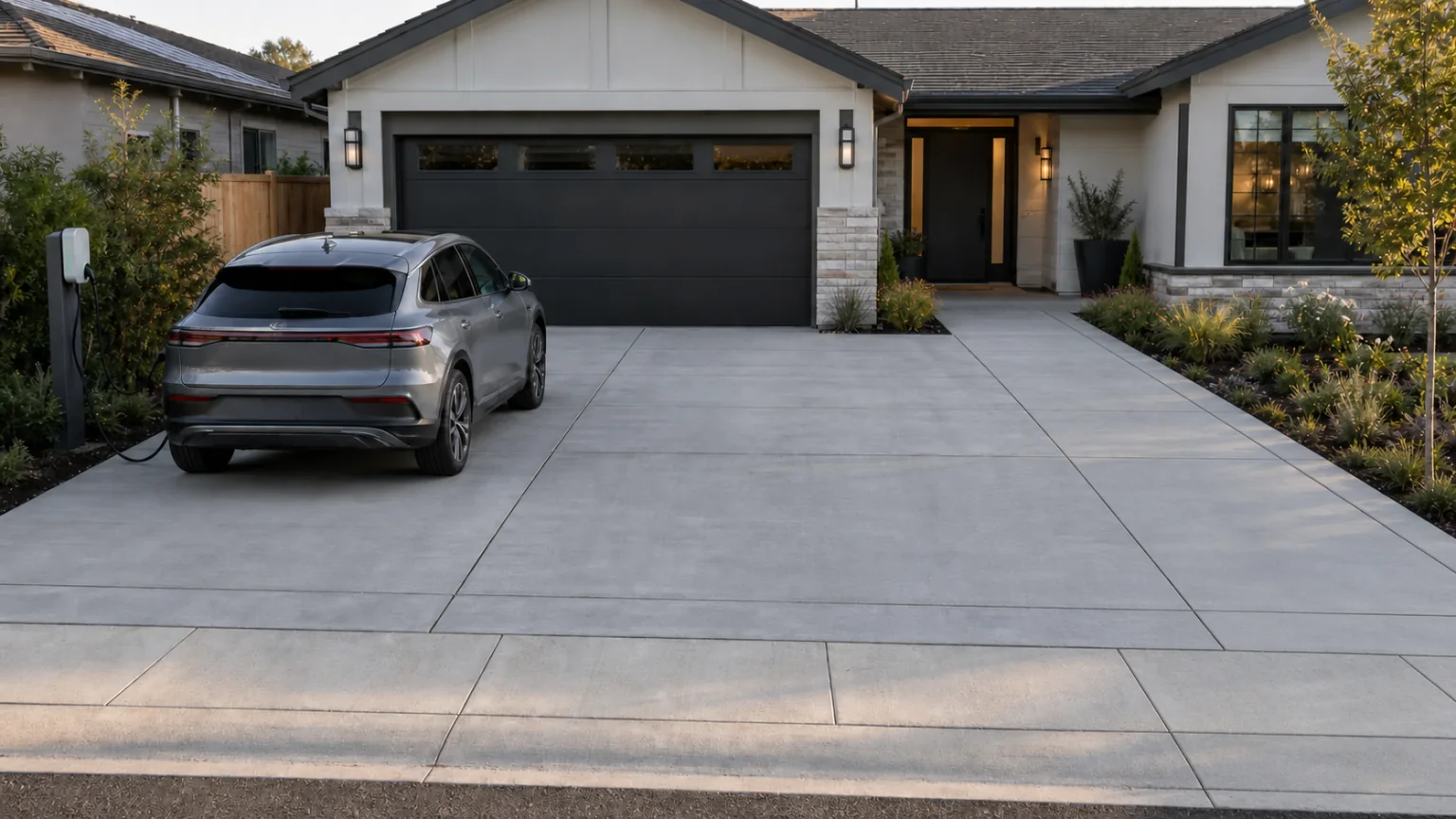
Charging works better when it is treated as a parking and circulation layout, not as a gadget added after the driveway is poured. The bay should widen directly from the main slab so the garage approach stays clear, the vehicle has a full hard-surface landing, and the public sidewalk or driveway apron still connects cleanly to the front door without a planted notch or squeeze point.
- The tradeoff
- A dedicated bay makes charging easy and keeps the main lane free, but it adds paved area and electrical infrastructure.
- How to measure it
- Conceptual range: the main driveway rectangle plus the flush charging turnout, the continuous sidewalk-to-entry connection, and any utility pad or conduit route.
On your property
Plan it for your site
Use the same durable broom-finish concrete for the main drive, charging bay, and entry connection, with joints that mark the bay without creating a raised edge. Keep planting outside the access route, keep the charger blank and discreet, and plan conduit or service routing before the pour if the equipment is permanent.
- Keep the charging bay directly connected to the main driveway, with no grass, gravel, curb, or planting strip between them.
- Continue concrete through the sidewalk-facing access corner so people can move from the sidewalk or apron to the entry without stepping around a planting pocket.
- Set the charger where the cable reaches the vehicle without crossing a walk, driveway lane, door swing, or snow-clearing path.
Before forms are set
Build implications
- Confirm before estimating Charging-bay size, door clearance, and turning clearance for the main driveway.
- Confirm before estimating A broad, flush hard-surface route from sidewalk or apron to front entry, kept outside the parking footprint.
- Confirm before estimating Electrical service, conduit, pedestal or wall support, weather protection, and a short cable route clear of walking and backing paths.
- Measure the site and establish elevations Record boundaries, thresholds, grade changes, utilities, and the dimensions of vehicles, furniture, equipment, or structures that affect the layout.
- Test how the space will be used Check walking routes, turning paths, door swings, working clearances, maintenance access, and the route back to the house or street.
- Resolve drainage, services, and structural support Decide where water goes and coordinate drains, conduit, irrigation, fuel, electrical work, footings, and independent supports before forms are set.
- Define and estimate each concrete element Confirm the slab or footing section, base, joints, edges, and finish, then estimate simple measurable fields separately from steps, walls, drains, and supported features.
Prevent these problems
- Planning the charger before the parked-car positionA misplaced unit can leave the cable stretched across a walk, behind the car, or in a tire path.
What changes the work and quote
- Electrical service, trench or conduit, charger location, and added slab areaKeep it simpler: Reserve a conduit route and install the charger when vehicle and service needs are known.
Next step
Turn the idea into your estimate
Enter the dimensions and section for your property. The image does not provide a takeoff.
Estimate your drivewayQuestions this idea raises
Why make EV charging its own bay?
A side bay lets the charging car stay plugged in without blocking the garage approach or creating a cable across the main route. The useful version is a flush turnout from the driveway, not a separated strip with planting in the way.
Where should planting go around an EV bay?
Keep planting outside the walking, door-swing, and cable zones. It can frame the driveway, but it should not interrupt the sidewalk-to-entry route or separate the bay from the main hardscape.
- Best when
- An EV can park beside the main drive without blocking other vehicles and the cable reaches the charge port without crossing a walk.
- Reconsider when
- The cable would cross circulation, the charger lacks weather protection, or utility capacity and permits are unknown.
- Verify first
- Choose the parking orientation and charge-port position, then have a licensed electrician plan power, conduit, protection, and equipment.
- Professional input
- A concrete contractor should confirm the slab, base, joints, and drainage. Ask an engineer or the local authority to review retaining work, structures, unusual loads, or public-right-of-way changes.
Sources and further reading
- NRMCA CIP 6: Joints in Concrete Slabs on GradeJoint spacing, panel shape, isolation, and saw-cut depth for slabs on grade.
- FHWA: Bases and Subbases for Concrete PavementsProfessional guidance on uniform support, subgrade risks, drainage, and stable base layers.
- U.S. Access Board: Accessible RoutesSurface, slope, clear-width, and route guidance where formal accessibility rules apply.