Design decision
Why this idea works
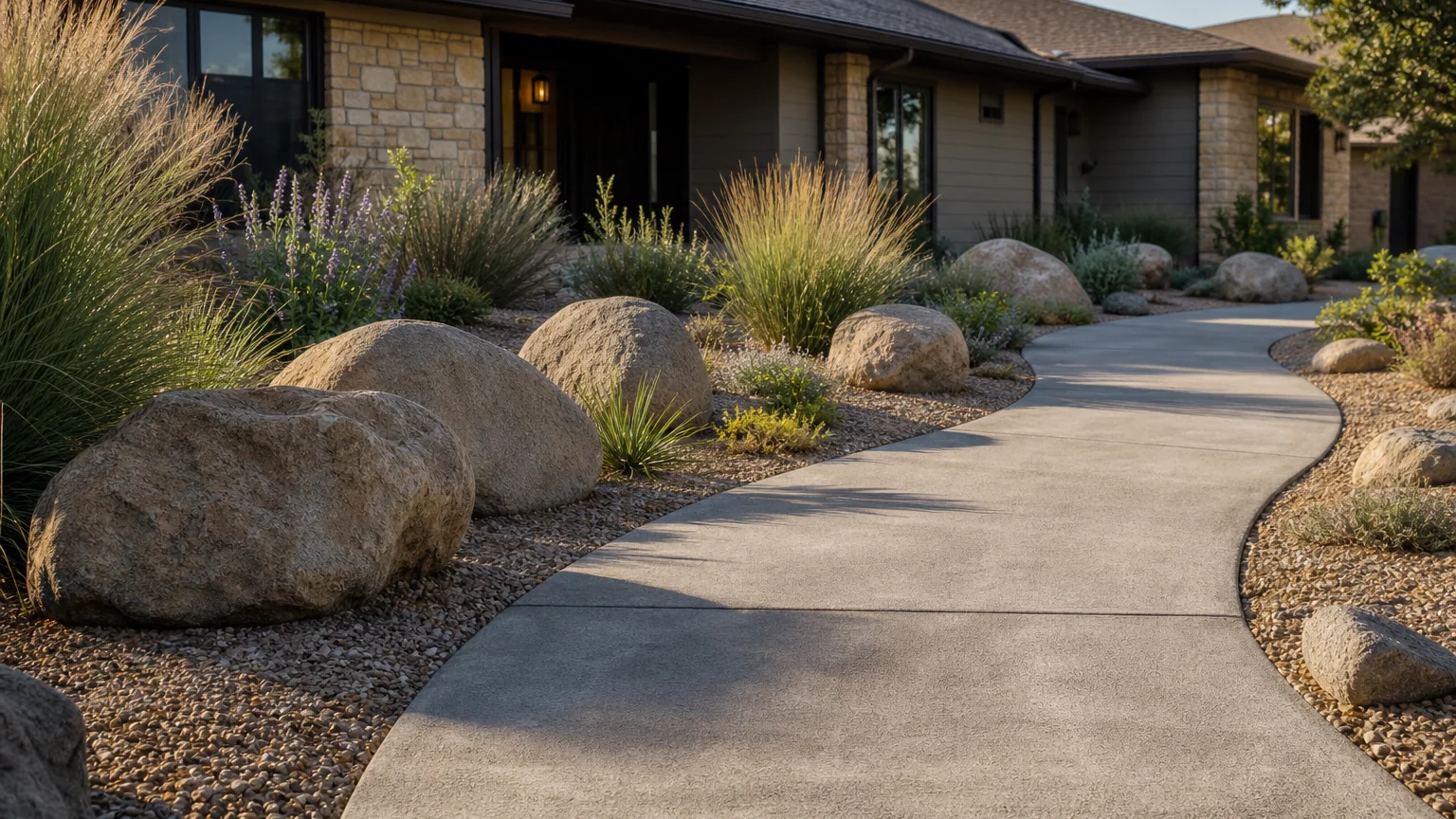
Boulders give a garden weight and permanence, and curving the path around a low boulder grouping makes those stones the anchor of the approach. The drought-tolerant planting keeps upkeep low and the curve lets the walk explore the rock composition.
- The tradeoff
- The layout sets a clear direction, but it also commits the project to fixed relationships. Set the boulders securely and lay out the curve around them before planting.
- How to measure it
- Conceptual range: the curved path measured as a shape, with the boulder garden figured separately.
On your property
Plan it for your site
Keep the path a simple broom field so the boulders and planting are the features, and lay the curve out full-size so it flows around the stones. Set the boulders securely on proper bearing so they do not shift, and detail a clean path edge against the gravel and planting.
- Set the boulders securely on proper bearing so they do not shift or settle.
- Lay the curve out full-size so the path flows around the stones.
- Detail a clean path edge against the gravel and drought-tolerant planting.
Before forms are set
Build implications
- Confirm before estimating Securely set, stable boulders.
- Confirm before estimating A full-size curve that flows around them.
- Confirm before estimating A clean path edge against gravel and planting.
- Measure the site and establish elevations Record boundaries, thresholds, grade changes, utilities, and the dimensions of vehicles, furniture, equipment, or structures that affect the layout.
- Test how the space will be used Check walking routes, turning paths, door swings, working clearances, maintenance access, and the route back to the house or street.
- Resolve drainage, services, and structural support Decide where water goes and coordinate drains, conduit, irrigation, fuel, electrical work, footings, and independent supports before forms are set.
- Define and estimate each concrete element Confirm the slab or footing section, base, joints, edges, and finish, then estimate simple measurable fields separately from steps, walls, drains, and supported features.
Prevent these problems
- Following the image instead of the natural routePeople normally take the shortest comfortable path, so a decorative curve that ignores daily movement quickly becomes inconvenient.
- Losing width at pinch pointsPlanting, lights, gates, door swings, steps, and furniture can reduce a generous-looking path to an awkward passage.
- Creating a low point at a thresholdSmall elevation errors can hold water beside a door, foundation, or step even when the rest of the path drains correctly.
Next step
Turn the idea into your estimate
Enter measurements from the property. The conceptual image does not provide a takeoff.
Estimate a similar walkwayQuestions this idea raises
How are large boulders set safely?
They are placed on firm bearing and often partly buried so they sit stable and look settled rather than perched. Set them so they cannot shift near a walk.
Why drought-tolerant planting with boulders?
It suits the dry, rocky look, keeps water and upkeep low, and lets the stone be the feature. Match the plants to the exposure.
- Best when
- Curved routes
- Reconsider when
- Reconsider the idea if threshold elevations, clear width, slope, and changes in level cannot be resolved on the property.
- Verify first
- Set the boulders securely and lay out the curve around them before planting.
- Professional input
- Concrete contractor; accessibility review where the route must meet formal requirements
Sources and further reading
- U.S. Access Board: Building blocksAccessibility context for clear width, walking surfaces, and changes in level where applicable.
- NRMCA CIP 6: Joints in Concrete Slabs on GradeA practical starting point for panel layout and crack-control joints.
- EPA: Soak Up the Rain with Rain GardensFederal guidance for deciding whether a planted runoff area can work beside a path.