Design decision
Why this idea works
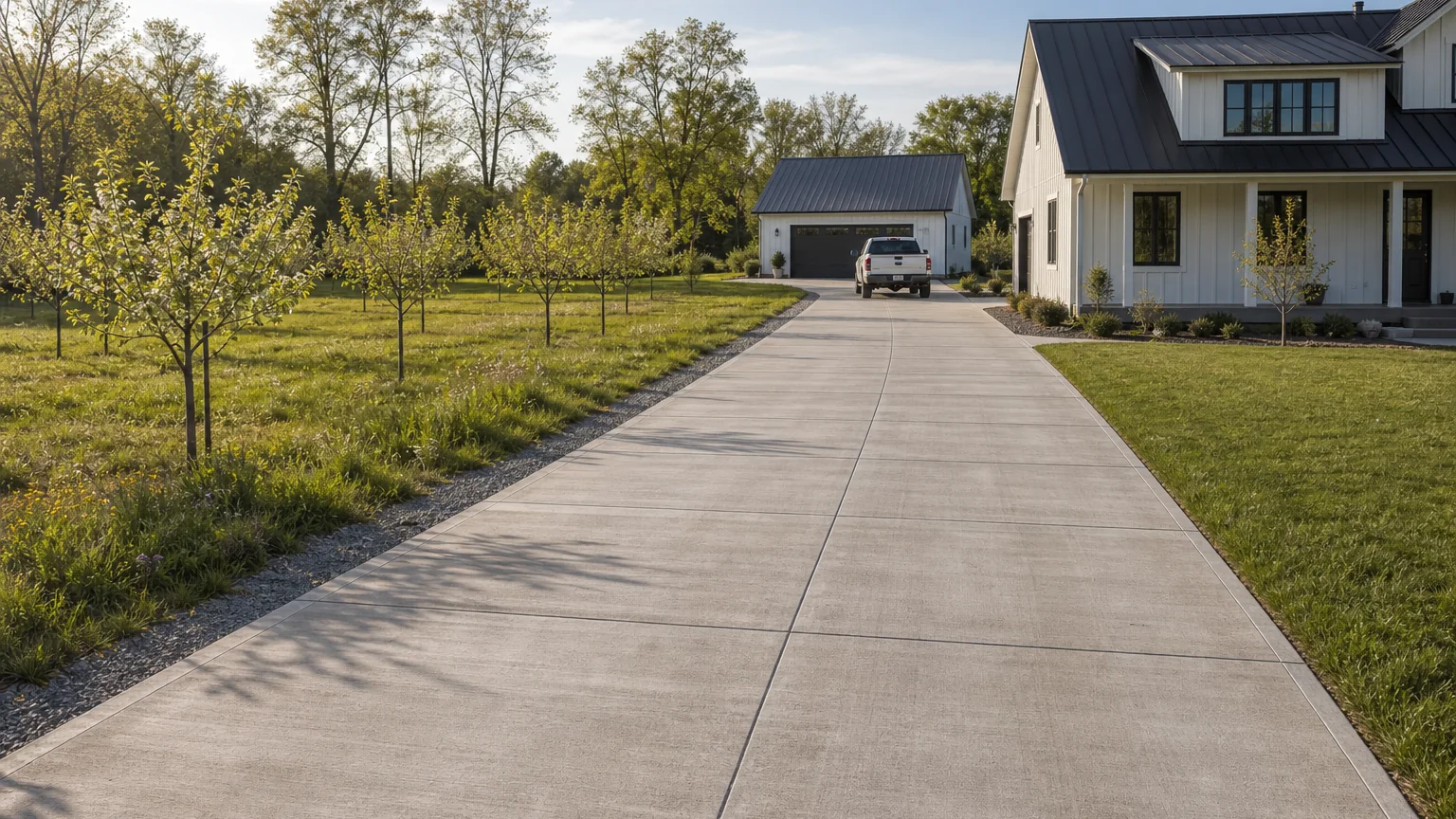
Running the drive past an orchard edge makes the approach feel like part of a working, living landscape rather than a bare strip of pavement. The concrete keeps the surface clean and firm while the fruit trees give the arrival seasonal character.
- The tradeoff
- The orchard softens the approach, but productive trees need soil, water, and access that paving can reduce.
- How to measure it
- Conceptual range: the driveway rectangle plus the orchard edge as its own planted area.
On your property
Plan it for your site
Keep the drive a simple broom field so the orchard carries the interest, and detail the slab edge clean where it meets the tree line. Set the paving and base back from the tree roots and drip lines so neither the trees nor the slab suffer.
- Set the paving and base back from the tree roots and drip lines so both survive.
- Detail the slab edge stable against the planted orchard ground.
- Keep fallen fruit and litter in mind so the drive stays clean and safe underfoot.
Before forms are set
Build implications
- Confirm before estimating A slab and base clear of orchard root zones.
- Confirm before estimating A stable slab edge against the planting.
- Confirm before estimating A finish and layout that stays clean under fruit drop.
- Measure the site and establish elevations Record boundaries, thresholds, grade changes, utilities, and the dimensions of vehicles, furniture, equipment, or structures that affect the layout.
- Test how the space will be used Check walking routes, turning paths, door swings, working clearances, maintenance access, and the route back to the house or street.
- Resolve drainage, services, and structural support Decide where water goes and coordinate drains, conduit, irrigation, fuel, electrical work, footings, and independent supports before forms are set.
- Define and estimate each concrete element Confirm the slab or footing section, base, joints, edges, and finish, then estimate simple measurable fields separately from steps, walls, drains, and supported features.
Prevent these problems
- Planning around young tree sizeCanopies and roots expand into the drive when the layout uses current rather than mature dimensions.
What changes the work and quote
- Root protection, irrigation changes, pruning access, and edge drainageKeep it simpler: Keep one generous planted setback rather than fitting trees close to both sides.
Next step
Turn the idea into your estimate
Enter the dimensions and section for your property. The image does not provide a takeoff.
Estimate your drivewayQuestions this idea raises
How far should the drive be from fruit trees?
Far enough to clear the root zones and drip lines so paving does not damage the roots and roots do not lift the slab, which depends on the species and mature size. Give a real setback.
Will fallen fruit be a problem on the drive?
Fruit drop can stain and make a surface slick, so a broom finish and a small setback help, and keeping the drive swept manages the rest. Consider it when placing the paving.
- Best when
- An orchard edge can stay outside root zones and the drive provides equipment access without compacting planting soil.
- Reconsider when
- The slab would cover major roots, block irrigation, or place vehicles against low branches and fruit drop.
- Verify first
- Map mature canopy and roots, irrigation, equipment width, drainage, and maintenance paths.
- Professional input
- A concrete contractor should confirm the slab, base, joints, and drainage. Ask an engineer or the local authority to review retaining work, structures, unusual loads, or public-right-of-way changes.
Sources and further reading
- NRMCA CIP 6: Joints in Concrete Slabs on GradeJoint spacing, panel shape, isolation, and saw-cut depth for slabs on grade.
- FHWA: Bases and Subbases for Concrete PavementsProfessional guidance on uniform support, subgrade risks, drainage, and stable base layers.
- U.S. EPA: Types of Green InfrastructureHow rain gardens, swales, and permeable pavement store, slow, or infiltrate runoff.